
Pope Leo’s First Anniversary
Reflecting on the Significance of May 8

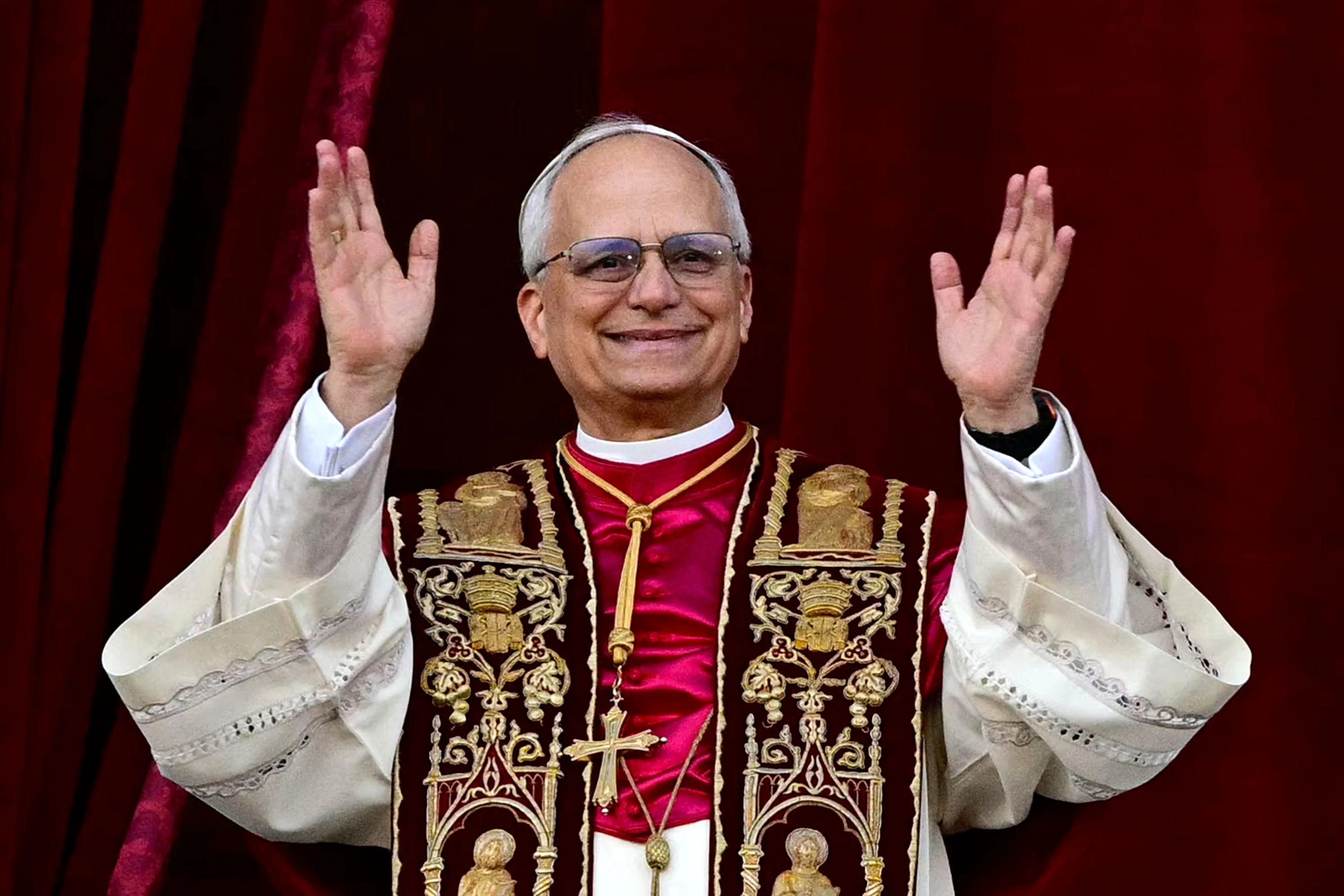
Pope Leo XIV makes his first appearance from the loggia of St. Peter’s Basilica on May 8 (Tiziana Fabi/AFP/Getty Images)
Last Friday marked one year since the election of Robert Francis Prevost as Pope Leo XIV. His predecessor, Pope Francis, made his last public appearance on Easter Sunday and died on April 21, Easter Monday. The conclave to choose his successor began 16 days later on May 7. The following day Cardinal Prevost was elected on the fourth ballot. In speculation before the conclave, he was regarded as papabile (literally “pope-able”) but a dark horse at best, in no small part due to his American ancestry. Upon his election, Leo became the second pope from the Americas (after Francis), the first born in the United States, the first Peruvian (he became a citizen in 2015), as well as the first from the Order of Saint Augustine. The conventional wisdom I had been told was that an American would never become pope in my lifetime, so I was utterly shocked when the new pope was unveiled to see a native of Chicago waving at me from the loggia of St. Peter’s Basilica. Even now, I’m still getting used to the reality of an American pope. In honor of the first anniversary of Leo’s papacy, I would like to explore its significance within the context of our present moment, and also of history.
Like most, I had no idea who Robert Prevost was until he became Leo XIV. This is a departure from his predecessors. As archbishop of Buenos Aires, Jorge Bergoglio was Argentina’s most prominent Catholic for 15 years before he became Pope Francis. And Joseph Ratzinger had been one of the Church’s most distinguished theologians as the head of its primary teaching office, then known as the Congregation for the Doctrine of the Faith, for almost a quarter century before he was made Pope Benedict XIV. To describe the contrasts between successive papacies, the Italians have a saying, papa grasso, papa magro, “Fat pope, thin pope.” This adage refers not only to the physiques of popes, but their personalities and theological emphases as well. The idea is that the cardinal electors often choose a candidate who can balance out the perceived shortcomings of the previous pope. While not a hard and fast rule, I do think there is something to it. Benedict, a conservative and somewhat dour German, was succeeded by Francis, a jovial and reforming Argentine who captivated the media. So far, Leo has not been a figure of change in the Church, but one who stands for continuity, humility, and respectful engagement. His call for a renewed cinema demonstrates an appreciation of the importance of popular culture. But what I believe has most distinguished Leo’s papacy is his courage in speaking out about some of the idols of our time. He is one of few world leaders to publicly question AI. And Leo has stood up to the idolatry of powerful politicians.
By an interesting coincidence, the reason I thought there would never be an American pope in my lifetime has a lot to do with another May 8. Last Friday was also the 81st anniversary of Victory in Europe (V-E) Day. On May 8, 1945 (which was also President Harry Truman’s 61st birthday), the armed forces of Nazi Germany unconditionally surrendered to the Allied powers. Victory in World War 2 left the United States a superpower. With America’s preeminence in the postwar world order, an American as pope would have been too much for too many. But the postwar world order is showing its age. According to Strauss-Howe generational theory, history follows cycles lasting roughly 85 years, corresponding to a long human lifespan, and each cycle ends with a crisis in which the existing social, political, and economic order comes apart. Are we presently going through such a crisis? The unexpected election of Pope Leo seems like a sign of change, and possibly of American decline. The conflict the Trump administration launched in Iran, and its public dispute with the Vatican, does not bode well…
But May 8 is also the anniversary of another event which should give us hope. We need to reach back all the way to 1373. In Norwich, England a thirty-year-old woman named Julian was gravely ill and thought she was on her deathbed. On May 8, a curate administered last rites to her in anticipation of her death. As he held a crucifix above the foot of her bed, Julian began to lose her sight and feel physically numb, but gazing on the crucifix she saw the figure of Jesus begin to bleed. Over the next several hours, she had 15 visions of Jesus, with a 16th the following night. Julian was an anchoress, someone who had withdrawn from secular society to live a secluded life devoted to prayer. Within a week, she was completely healed, and wrote about her “shewings” shortly thereafter. Julian’s writings, now known as Revelations of Divine Love, are the earliest surviving English-language works attributed to a woman. The time in which she lived was a particularly dark period, even by the standards of the Middle Ages. Before receiving her visions, Julian had already lived through the Black Death, a pandemic which is estimated to have killed 30-60% of Europe’s population. The darkness of Julian’s time only makes the profound optimism of Revelations of Divine Love all the more remarkable. She declares, “All shall be well, and all shall be well, and all manner of thing shall be well,” for God loves us as both our father and our mother, with tenderness.
Last Friday marked the Holy Father’s first anniversary; and yesterday was Mother’s Day. Thanks to the Lord’s Prayer (Matthew 6:9-13), it is natural for Christians to think of God as “Father.” But it is not nearly as easy for many of them to refer to God as “Mother.” Yet God can clearly be revealed to us in the image of a loving mother. One thing that all the popes of my lifetime have in common is their tremendous devotion to Mary, the Mother of God. From the beginning of his papacy, Leo has consistently called on “our Mother” for guidance and protection. On May 25, just over two weeks after his election, Leo went to the Basilica of Saint Mary Major, the first Marian shrine, paying his respects at the tomb of Pope Francis and calling on the faithful to “renew our devotion to Mary.” It should come as no surprise that Leo chose to celebrate the first anniversary of his election to the papacy at another Marian shrine, explaining that it happened, “precisely on the feast of the Supplication to Our Lady, this beautiful Feast of the Supplication to Our Lady of the Holy Rosary of Pompeii,” so he felt compelled to go there “to place my ministry under the protection of the Blessed Virgin.” May our Mother watch over him and us!